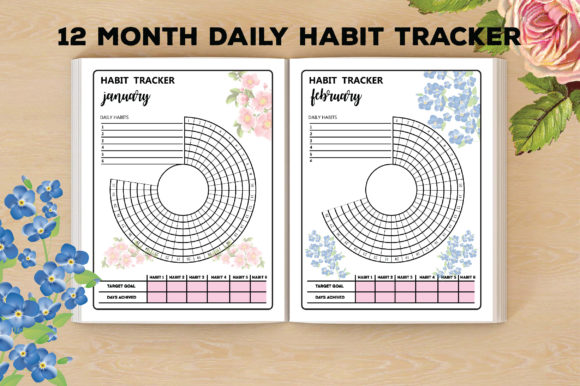
12 Month Daily Habit Tracker for Kdp Interiors & Branding
As a brand designer who spends most of my week tweaking vectors and selecting paper stocks for local entrepreneurs, I approach every new graphic design asset with a critical eye. It is not enough for something to look pretty on a screen; it must hold up under the harsh glare of retail lighting and the scrutiny of a customer holding a product in their hands. Recently, I evaluated the 12 Month Daily Habit Tracker from Kdp Interiors not for its intended use as a journal interior, but as a potential cornerstone for a real-world small business branding project. Specifically, I imagined applying this structured, clean aesthetic to a local wellness studio launching a new line of organic skincare products.
First Impressions: Structure Meets Softness
The immediate mood created by the 12 Month Daily Habit Tracker is one of grounded reliability mixed with approachable elegance. Unlike chaotic or overly decorative illustrations that scream for attention, this asset suggests a brand personality that is organized, mindful, and premium. For a local business like a boutique coffee shop or a handmade soap maker, this visual language communicates stability. It feels less like a fleeting trend and more like a foundational element of professional branding. The design hints at a routine, a journey, and a commitment to quality—values that resonate deeply with consumers looking for authenticity in a handmade business.
Transforming Interiors into Exterior Brand Identity
While categorized under Kdp Interiors, the utility of the 12 Month Daily Habit Tracker extends far beyond the pages of a book. In my hypothetical project for the skincare brand, I visualized using the tracker's grid structures and typographic hierarchy as the backbone for packaging design. Imagine a series of product boxes where the side panel features a simplified version of the habit tracker, inviting the customer to mark off their days of self-care. This transforms a static product label into an interactive experience.
Beyond packaging, this asset serves as a robust tool for logo design inspiration. The clean lines can be abstracted to create a monogram or a secondary brand mark that appears on hang tags and thank-you cards. For social media graphics, the layout provides a ready-made template for "30-Day Challenge" posts, driving engagement without requiring complex editorial design skills. Whether used as a background texture for a website banner or a focal point on a promotional flyer, the asset offers a versatile framework for marketing visuals.
Elevating Customer Trust Through Visual Consistency
One of the greatest challenges for small business branding is establishing trust quickly. A polished, consistent visual hierarchy tells the customer that the business owner cares about details. By integrating the 12 Month Daily Habit Tracker aesthetic across touchpoints—from the product mockup on the website to the physical printable design included in the shipping box—we create a cohesive narrative. This consistency improves product recognition on crowded shelves and fosters a stronger emotional connection. When a customer sees the same disciplined design language on a sticker, a menu graphic, and a price list, it reinforces the perception of a well-established, reliable brand.
Strategic Applications for Local Entrepreneurs
To get the most out of this design asset, it is crucial to deploy it where it adds value rather than clutter. Here is where the 12 Month Daily Habit Tracker shines in a commercial setting:
- Product Labels: Use the grid lines as a subtle background pattern to organize ingredient lists or usage instructions, enhancing readability.
- Packaging Accents: Incorporate elements of the tracker on the inside flap of a box to surprise and delight the customer upon unboxing.
- Hero Graphics: Utilize the bold headers for seasonal campaign visuals, such as "New Year, New You" promotions for gyms or wellness coaches.
- Social Media Campaigns: Adapt the monthly layouts for Instagram carousels that encourage followers to track their progress with your product.
- Thank-You Cards: Print a mini-version of the tracker on cardstock as a value-add gift with every purchase.
Where Caution is Required
However, a seasoned designer knows that more is not always better. There are specific contexts where the 12 Month Daily Habit Tracker should be used carefully. For luxury minimalist brands that rely on vast amounts of negative space, the detailed grids might feel too busy. Similarly, on very small labels where legal information and barcodes compete for space, adding decorative tracking elements could reduce legibility. It is also ill-suited for formal corporate branding where a stark, sans-serif identity is required. If the decoration competes with important text, such as allergen warnings on food packaging, it must be scaled back or removed entirely. Always ensure there is sufficient contrast if placing these elements on low-contrast backgrounds.
Practical Notes from the Design Studio
Before committing to this asset for a client project, I run through a rigorous checklist to ensure commercial viability and print readiness. First, test the design on real product mockups to see how the lines translate to physical materials like kraft paper or glossy plastic. Check how the design performs in black and white, as many local businesses print receipts and invoices in monochrome. Preview the asset on small labels to ensure the fine lines do not blur during the printing process.
It is also vital to test the asset with your existing typography. Does the structured nature of the tracker complement your chosen serif, sans serif, script, or display font? Often, pairing a rigid grid with a flowing handwritten font creates a delightful tension that feels modern and organic. If you are working with digital files, inspect the PNG design for transparency issues and check if an SVG design or vector version is available for infinite scalability without pixelation. Finally, and most importantly, confirm the commercial license terms. Ensure that using a Kdp Interiors product for external commercial design projects, such as physical product sales or client branding, is explicitly permitted. Never assume a license covers all use cases; protecting your business and your client is the first rule of professional practice.
In conclusion, the 12 Month Daily Habit Tracker is more than just a journal interior; it is a flexible graphic design asset that, when applied with intention, can significantly elevate the brand identity of a local business. By focusing on visual hierarchy and consistent application, entrepreneurs can turn a simple layout into a powerful tool for customer engagement and brand loyalty.